

World Press Photo is the most prestigious photojournalism award in the world. Now running for the 67th year, it was conceived in 1955 by the World Press Photo Foundation, an independent non-profit organisation based in Amsterdam. This year, 4066 photographers from 130 countries entered the competition, submitting a total of 64,823 candidate images. The entries were assessed by regional panels of judges and a global panel of 31 judges.
Unlike previous years, when it was organised into thematic categories, this year the competition is divided into six geographical areas. The macro areas are Africa, Asia, Europe, North and Central America, South America, Southeast Asia, and Oceania. Each area has four categories: Singles, Stories, Long-Term Projects, and Open Format. Out of the 24 winners in each of the four categories, the judges selected the four global winners: the World Press Photo of the Year, the World Press Photo Story of the Year, the World Press Photo Long-Term Project Award, and the World Press Photo Open Format Award.
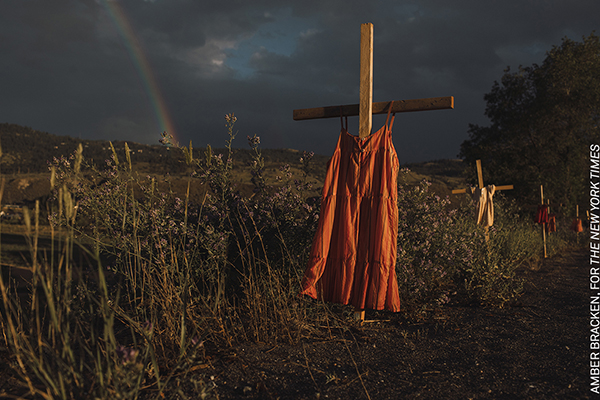
The title of World Press Photo of the Year was awarded to the Kamloops Residential School shot by Canadian photographer Amber Bracken. The image captures a succession of red dresses hanging from crosses along the side of the road: a sort of open-air memorial to commemorate the 215 children who died at the Kamloops Indian Residential School in Canada, where the children of local native families were forcibly sent, whose remains were found in a mass grave.
The Story of the Year award went to the Saving Forests with Fire project by the Australian Matthew Abbott. The series documents the practice of controlled forest fires that the Nawarddeken of West Arnhem Land, Australia, have used to manage their lands for thousands of years.
The winner of the Long-term Project Award was the shot Amazonian Dystopia by the Brazilian photographer Lalo de Almeida. The series documents the exploitation of the Amazon Rainforest, which has advanced apace under the Bolsonaro government. The Open Format Award went to Blood is a Seed by the Ecuadorian photographer Isadora Romero, who presents a personal story set in the village of Une in the department of Cundinamarca, Colombia, addressing issues such as biodiversity loss, forced migration, and colonisation.
Opening hours
Weekdays: 10 am | 6 pm
Saturdays, Sundays, public holidays: 10 am | 7 pm
Closed on Mondays
Rates
Full-price: € 8.00
Concessions (over 65 and 6-18 years): € 7.00
